
There is no planner supply shortage
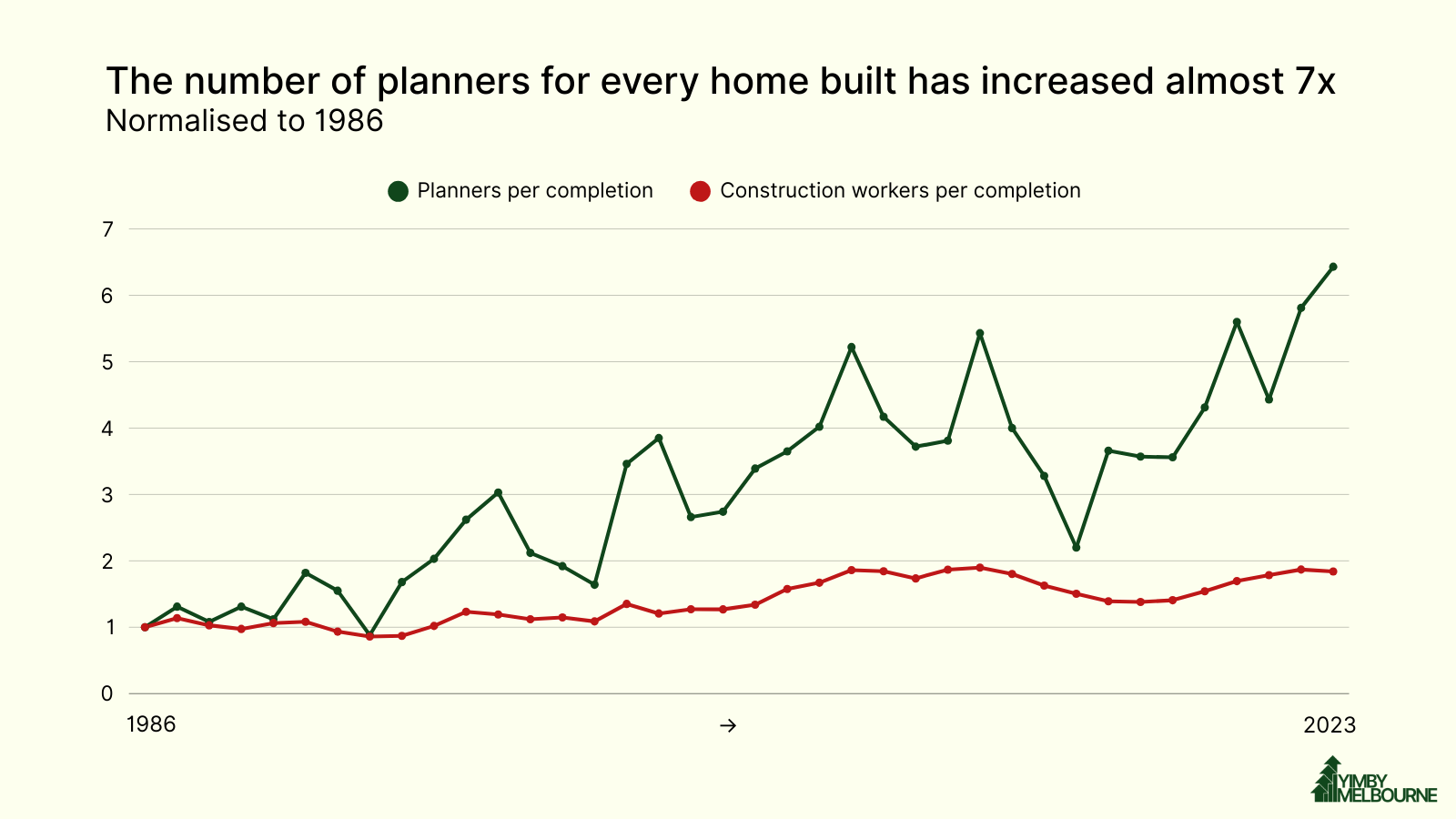
In 1986, we delivered 54 homes per planner. Now, we deliver fewer than 9 homes per planner. Red tape has created a productivity crisis that more planners can't fix.
Key findings
- Planning peak bodies have declared an emergency planner shortage, and stated that the only viable solution is to increase planner supply
- But in 1986, Australia built 54 homes for every practicing planner
- And in 2025, that number has dropped to fewer than 9 homes per planner
- In 1999, it took 55 days to get a permit for 10 dwellings
- In 2022, it took 371 days to get a permit for 10 dwellings
- This large reduction in planner output has accompanied an enormous increase in planner supply, with the number of practicing planners increasing much faster than housing costs over the same time period
- To solve this complex problem, we must examine not only planner supply, but also planner demand
Planner productivity has collapsed while numbers soar
Australia’s planning system is failing at an unprecedented scale. Despite peak planning bodies claiming an emergency planner shortage, new research from YIMBY Melbourne reveals the number of practicing planners has increased ninefold since 1986—while the number of homes built per planner has plummeted by 85%.
The research, led by William Oliver and Jonathan O’Brien, analysed four decades of planning workforce and housing delivery data to expose the real crisis facing Australia’s planning system.
In 1986, Australia built 54 homes for every practicing planner. Today, that figure has crashed to fewer than nine homes per planner.
This dramatic productivity collapse has occurred even as planner numbers have grown far faster than population or housing costs.
Red tape explosion drives artificial demand for planners
The research exposes how regulatory complexity has created artificial planner demand that far outstrips supply.
In Victoria, housing permit timelines have blown out from 55 days in 1999 to 371 days in 2022—a sevenfold increase. Meanwhile, major infrastructure projects now proceed at a fraction of historical speeds, with road delivery rates dropping from 10km per year to just 3.25km per year.
This isn’t a supply problem—it’s a demand crisis driven by byzantine planning rules that require ever more planners to process ever fewer homes.
Interstate comparison reveals the real culprit
If NSW planners matched their South Australian counterparts, the state would build an additional 33,403 homes annually.
The difference between the states? South Australia’s codified planning system requires minimal discretionary assessment, while states like Victoria and NSW drown in process.
Peak planning bodies calling for more planner supply are addressing the symptom, not the disease.
Key chart
Quotes
Quotes attributable to Jonathan O’Brien, Lead Organiser
“Peak planning bodies are like doctors prescribing more bandages for a patient who keeps getting stabbed. We don’t need more planners—we need to stop the regulatory bleeding that’s making each planner less productive than ever before.”
“In 1986, one planner could facilitate 54 homes being built. Today, it takes six planners to do the same job. That’s not a labour shortage—that’s a productivity catastrophe driven by planning rules that prioritise process over homes.”
“If we hired enough planners to restore 1986 productivity levels without fixing the underlying system, we’d need to employ one in every 50 working Australians as a planner. The solution isn’t more bureaucrats—it’s less bureaucracy.”
Related
Australian Zoning Atlas
The Australian Zoning Atlas is the first ever nation-wide map that classifies and compares residential planning controls across Australia.
Federal Homes for Australia plan puts planning reform where it belongs: at the centre
Abundant Housing Network Australia welcomes the Commonwealth Government’s National Plan, and calls on all states to match or exceed Victoria’s ambition on planning reform.
Federal budget finally serious about housing supply
The budget's housing supply package finally begins dismantling the structural barriers that have locked younger generations out of the market.