
Don't we have enough homes already?
A small portion of dishonest commentators enjoy claiming that Australia has enough homes already, and that we do not need to continue building. This is untrue. While Australia used to grow its housing stock much faster than its adult population, this is no longer the case.
This is not a story about migration, either: the annual growth rate of dwellings has been declining from the 1970s onward.
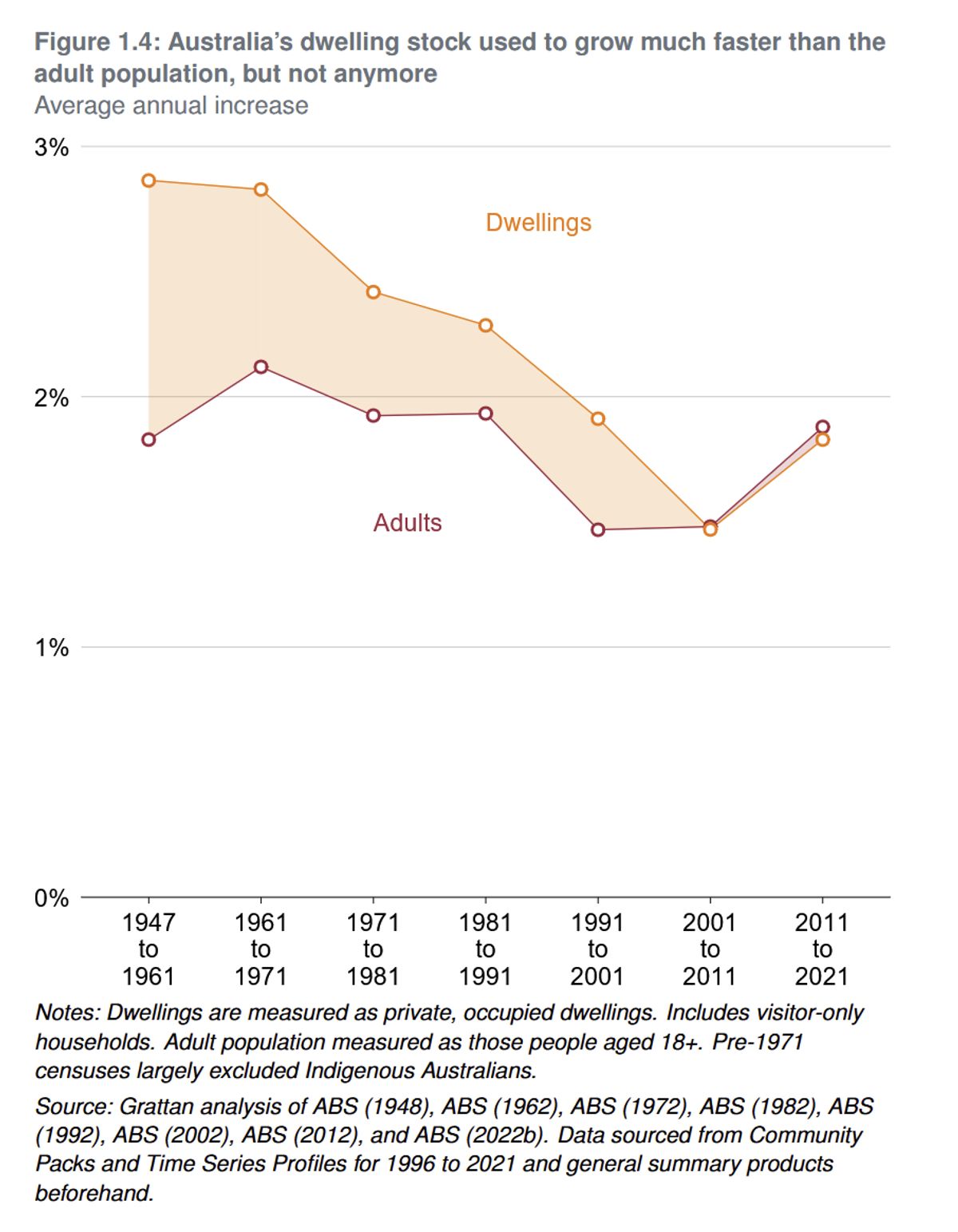
The shortage is more acute than it appears, because both household sizes and the shape of the economy have changed.
The average household size has dramatically decreased over the past few decades. In the 1980s the average household size was more than 2.8 per home; today the average is closer to 2.5. This means our current population requires almost 1.2 million more homes than if household sizes were still the size they were in the 80s.
The economy has also shifted. There are many extremely affordable homes across regional areas, but they aren’t in the places with access to a diversity of jobs and opportunity. The shortage of homes is most acute in places where people want to live, and where development has been constrained for decades by arbitrary planning controls that drive up housing costs by making it illegal to build denser, more affordable housing in places where people want to live.
Australia needs more homes. Specifically, we need more homes in high-demand, inner-city areas, in line with both changing population demographics and a modern, more services-driven economy.
More FAQs
Questions & Answers
Are YIMBYs aligned with any political parties?
About us
+
Yes, all of them!
YIMBY Melbourne has members from across the entire political spectrum. We're united by one thing—the overwhelming evidence that building more homes where people want to live reduces rent and housing costs.
No single political ideology is purely “NIMBY”, and neither are any of them “YIMBY”.
Housing abundance is the only guiding principle of our movement, and this principle unites people across partisan and ideological lines in service of a better future for Melbourne, and other cities around Australia and the world.
How is YIMBY Melbourne funded?
About us
+
How is YIMBY Melbourne funded?
YIMBY Melbourne receives funding through membership fees and donations from our members and supporters, as well as their volunteer time, which helps build resources like this FAQ. Without our members, we would not be able to do all we can.
Thanks to a generous core funding contribution from Coefficient Giving in 2024, YIMBY Melbourne was able to begin paying staff for the first time. Coefficient Giving has been a key supporter of YIMBY movements across the globe, and their support enables us to undertake research and advocacy for housing abundance in Australia, and in turn to export the best of Australian policymaking to the rest of the world.
YIMBY Melbourne does not accept financial contributions from property developers, urban planning businesses, real estate interests or political parties.
I'm not from Melbourne. How can I help?
About us
+
YIMBY Melbourne is proud to be part of a national network of grassroots organisations organising their cities’ residents to support more homes, better transport and a city that works for everyone.
The Abundant Housing Network is a national alliance of independent, grassroots campaigners working to build a new vision for housing and cities—one that’s more sustainable, liveable and affordable for everyone.
Our sibling organisations — Greater Brisbane, Greater Canberra and Sydney YIMBY — joined with us to forge a new urbanist politics that brings together everyone who loves our cities and wants to welcome more neighbours into them.
Together, we advocate for national policy changes that would help deliver more homes and better cities for all Australians. Our landmark 2025 election briefing, the Brick Book, outlined shovel-ready housing policies the Commonwealth could deliver right now in order to boost housing supply and make homes more affordable and safer for all Australians.
If you live in Brisbane, Canberra or Sydney, we encourage you to sign up and get active with our sibling organisations.
If you live in another city and you’re keen to get organised, reach out to hello@abundanthousing.org.au and we’ll help!
What has YIMBY Melbourne achieved?
About us
+
Since YIMBY Melbourne was founded, Victoria has undertaken what has been described as one of the most significant sets of planning reform in the state’s history.
YIMBY Melbourne has been honoured to play one small part in this revolution. From delivering cutting-edge research and advocacy, to representing the silent majority of pro-housing Victorians in the media, we have been proud to work as one stakeholder of many in this period of positive reform.
You can view a full list of our achievements detailed across the Impact section of our website.
What is a YIMBY?
About us
+
YIMBY stands for Yes In My Backyard, and describes an attitude of urban optimism—one that embraces development and change across our local communities.
YIMBYs advocate for more homes to be built where people want to live, and for the creation of more liveable, affordable, and sustainable cities for all. That means more and better access to public and active transport, and more dense and vibrant suburbs in our cities that garner thriving communities and the next generation.
YIMBYism exists in direct contrast to NIMBY—Not In My Backyard—attitudes, which favour stasis, and assert the privileged status of incumbent landowners to stop new homes and infrastructure from being built in their local area.
The NIMBY benefits massively from living in the city, but protests whenever any of the growth or change inherent to city living occurs locally—in their backyard.
For more on this phenomenon, we recommend the 2025 paper How the Gentry Won: Property Law's Embrace of Stasis.
What kind of homes does YIMBY Melbourne advocate for?
About us
+
YIMBY Melbourne advocates for all kinds of new homes—as long as the end result is more of them!
We want to see Melbourne, Victoria, and Australia more broadly build as many homes as possible as quickly as possible to enable everyone living in our nation to have a safe, secure, and affordable place to live.
To achieve this, we need to reform the policies that govern our cities, and make it illegal or prohibitively difficult to build homes in the places people most want to live.
To put it simply: we believe people should have a greater number of housing options, all across our city, so that families and individuals can rent or purchase the home that is the best fit for them—for every stage of life.
What's the problem with building setbacks?
About us
+
Building setbacks, whilst often argued for with good intentions, have a large number of negative ramifications that make our housing outcomes worse.
The issues with setbacks fall into two main categories: increasing building complexities and decreasing amenities.
To put it simply, buildings with a traditional “boxy” shape are just simpler (and cheaper) to build and maintain whilst more complex shapes do the exact opposite. The more setbacks required the more complexity goes to the building foundations, waterproofing, service/infrastructure, etc. All these factors add up and not only just significantly increase the construction costs, they make the long term performance of buildings likely to be worse.
This is backed up by research from the City of Toronto Planning and Development Department, who found that the elimination of setbacks would lead to "the greatest reductions in both embodied and operational carbon and have the additional benefit of simplified structures and envelopes - a move that would allow a wider range of structural materials to be employed and greater energy efficiency in envelope systems".
There is research to suggest that setbacks—via the extension of internal floor slabs—can cause buildings to lose thermal efficiency due to thermal bypassing. This is in addition to them being less thermally efficient from the onset due to having a larger surface area to their volume, compared with buildings without setbacks. These two factors combined means that setbacks cost more and produce more emissions due to their much higher energy requirements. These increased amounts of points of potential water ingress also create more unnecessary risk for timber rot and for the growth of mould.
Whilst the rationale for setbacks is often based around improving the amenity of the streetscape (i.e. how tall the building appears on the street level) this often comes at the cost of amenity of the residents of the building and relies on the assumption streetscapes are inherently better when the building height is obscured.
The nature of setbacks means that the bottom levels of the building needs to be long enough to meet the required setback requirements of the upper levels. However, this means that the housing on lowest levels are built deep into the building with more limited access to light and airflow when there are other buildings surrounding the rear. This issue is one exacerbated by setbacks and could be solved by removing setbacks and allowing for a thinner rectangular building with plenty of rear open space.
On the upper levels, the long setbacks completely block residents' views of the streetscape, cutting off their connection with the street whilst removing the safety benefits of “passive surveillance”.
Moreover, setback requirements force developments to have reduced floor area ratio (FAR)—otherwise known as ‘density’. In practice this means the number of homes a project can supply is either reduced or the apartment sizes/number of bedrooms are reduced. The former has implications to housing affordability whilst the latter limits the type of housing diversity that can be delivered by these projects.
Many advocates for the current setback regime argue that they play a vital role in preventing urban canyoning or wind tunnelling—which are fair concerns and worthy of addressing through policy and planning tools. However, the height buildings need to be for these concerns to be valid is significantly disconnected from when setbacks requirements kick in. For example with wind tunnelling, buildings need to be around 20 stories or 76 metres tall before it becomes an issue whilst setback requirements can start as low as 2 storeys or 8 metres!
Another notable argument for setbacks surrounds overshadowing and sunlight. The current controls operate under the assumed supremacy of goals to minimise the amount of shadow cast and maximise the amount of sunlight. However, this assumption is falling under greater scrutiny in a world where heat is seen as a great threat to urban public health. Is minimising shade in urban spaces worth prioritising above all other amenity concerns? In Melbourne—a city famous for its cloudy weather—is overshadowing such a major concern for a majority of the year if the sunlight is mostly diffused? These are questions that have yet to be explored thoroughly in Melbourne.
When considering the number of trade offs associated with mandating setbacks, it’s hard to see why they’re worth it for the limited scope, and questionable nature, of the perceived benefits. Setback controls in Melbourne are in desperate need of a rethink.
Why should I join YIMBY Melbourne?
About us
+
You should join YIMBY Melbourne to become part of a hundreds-strong movement to build more homes where people want to live.
Becoming a YIMBY Melbourne member enables you to make a small but meaningful financial contribution to our work, and to become a member of our burgeoning community.
In addition to our core research and advocacy work, we also host events including our monthly happy hour, volunteer days, advocacy workshops, and more.
Membership starts at just $20 per year, with discounts available for students and other concessions.
Don’t high approval rates for developments mean planning reform isn’t needed?
Building & Construction
+
High approval rates are often exaggerated, and we analyse this data further in our research note: No, Councils don't approve 98% of permits for new housing.
In addition to the data explored above, there are a number of other considerations:
- All planning approval statistics are subject to selection and survivorship bias: permits will never be submitted for homes that are outright illegal to build.
- Many planning approvals are subject to significant conditions that may make a project unviable. For instance, a Nightingale development was once ‘approved’, subject to removing an entire floor.
- Many planning processes take extended periods of time, subjecting development to significant holding costs. If a permit is approved only after two or more years in planning purgatory, there is every chance that other conditions have changed, and the project may have been rendered unviable compared to if it had been approved within the statutory timeframe (typically sixty days).
The most important planning reform involves repealing bans, rather than reducing burdens. For more on this, we recommend Matthew Maltman’s Best Practice for Supply-Side Reform, published by Inflection Points.
Why aren't new buildings beautiful?
Building & Construction
+
We shouldn’t impose aesthetic rules or preferences on buildings because that takes away people’s choice and makes it less likely that vulnerable people can afford a roof over their heads.
Architects, builders and developers all across Australia are still building beautiful and innovative buildings — but these tend to mostly be civic or commercial because that innovation and design thinking commands a major premium on cost. That additional cost is not always something people want to bear when they’re looking for a new home to rent.
Many aesthetic features were engineering responses to environmental and construction problems like water flow, air distribution etc. Changes in materials, new construction technology and the relative cost of labour meant that the same problems could be solved quicker and cheaper.
The aesthetics of new buildings provoke a range of strong opinions, but it’s worth keeping a few things in mind. The look of buildings has changed along with the tastes, technologies, and use of buildings throughout the course Melbourne’s history. For example, newer buildings are more efficient to heat and keep cool, are more generously daylit, and reflect our changing needs, such as the provision of home offices in a post-COVID city. New homes may not always look like what we built in the past, but we can, and are, doing better in terms of sustainability and amenity.
It is worth noting also that many of Melbourne's most iconic buildings are illegal to build across a large proportion of our inner-city—a status quo enforced by our restrictive planning system. The three-storey terrace houses on our most desirable streets such as South Yarra, are illegal to build in the Neighbourhood Residential Zone (NRZ) that covers most of the city and imposes a 2-storey limit and large setbacks. Six-storey Hausmann-style buildings face even greater barriers. In the meantime, the Cardigan House car park has been heritage listed, locking the inner Carlton site away from more economically productive—and attractive—uses.
From rows of terrace houses to the boulevards of Paris and Barcelona, many traditional urban forms that Melburnians love and draw inspiration from have been made illegal to build anew in vast swathes of our city.
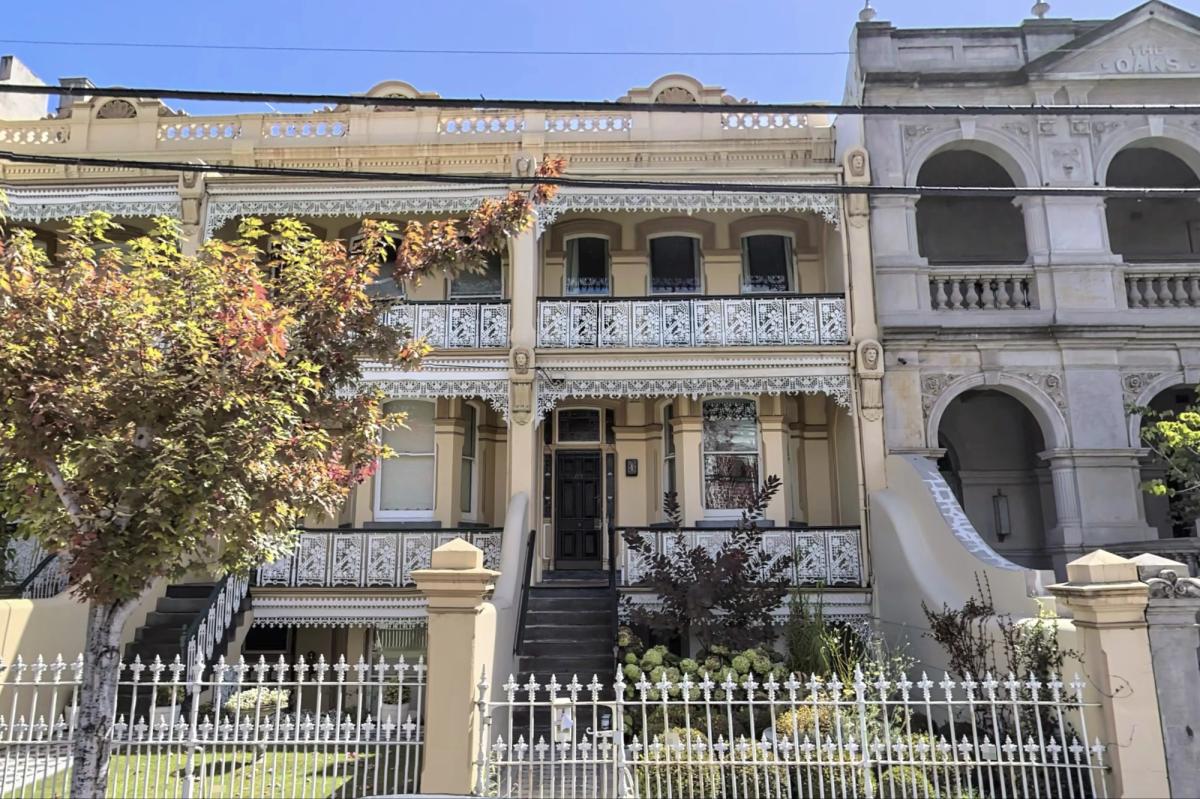
Three-storey terrace housing in South Yarra, now not permitted by-right in NRZ
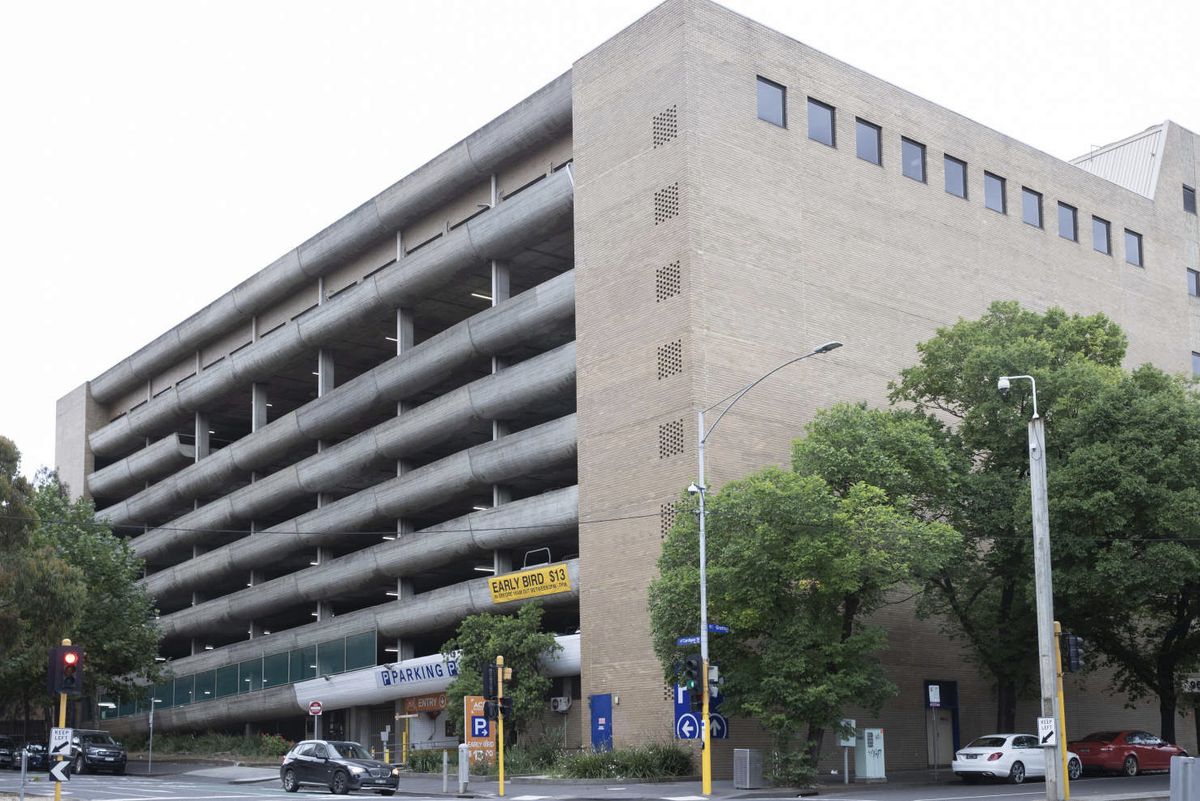
The newly heritage-listed Cardigan House car park
When we do build 6-storey mixed-use, it is often the design rules intended to improve aesthetics that result in unimpressive design. Where a Parisian street will be flanked by high facades, even sympathetic attempts to build up along Melbourne’s commercial corridors will be compromised by hard setbacks and concerns about monolithic blocking.

Melbourne-style setbacks would greatly detract from this Parisian street
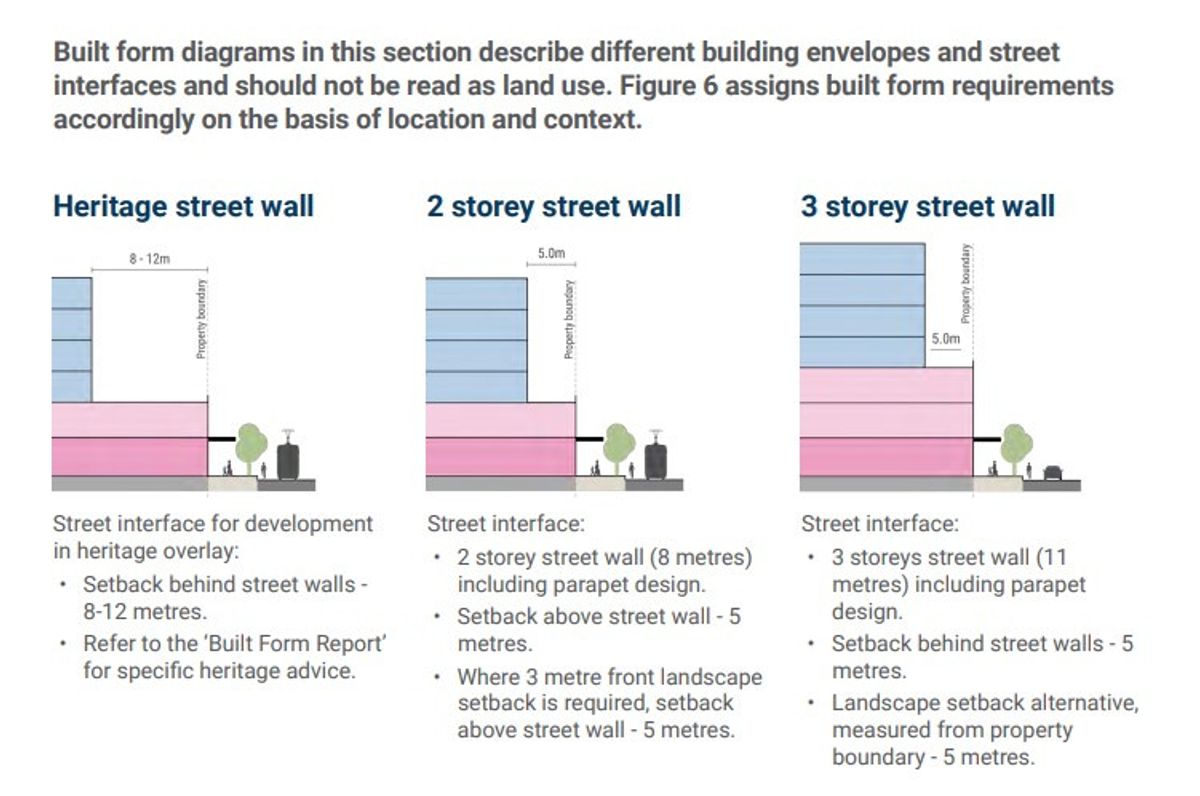
Setbacks mandated by the 2023 Camberwell Junction Structure and Place Plan
Melbourne remains one of the most architecturally interesting and vibrant cities in the world, and the old-to-new bricolage of our inner suburbs plays a large part in this. In attempting to proscribe what others may build on their land, we should be mindful that many of our prior attempts to tighten control over the look of our built environment have backfired.
But times are changing. With 58 percent of people in Greater Melbourne having parents born overseas, we now draw on a much broader range of European and Asian examples that show how urban life can be both densely walkable and humanely designed. And great, iconic builds such as Austin Maynard Architects' ParkLife are demonstrating how housing can be beautiful, affordable, and accessible to a wide range of Melburnians. Zoning for more medium density, as we at YIMBY Melbourne call for in our Missing Middle report, will enable more builds of this calibre to be built across this city of ours.
What is density? Is it the same as height?
Definitions
+
Density typically has two main definitions:
- Population density: the number of people housed per square kilometre of land, and
- Built density: the total area of floorspace constructed per square kilometre of land.
Floorspace is not always residential. For instance, office buildings do not increase population density in a given area, but they do increase the built density.
The height of a building is a large determiner of density. But there are many other planning controls that also impact density, such as setbacks, floor-area ratios, and minimum dwelling sizes. Planning controls may also place explicit limits on the number of dwellings permitted in a given area, though as of 2026 this kind of control is uncommon across metropolitan Melbourne, and much more common in other jurisdictions such as New South Wales.
What is inclusionary zoning, and does it work?
Definitions
+
Inclusionary zoning (IZ) is a policy that requires new housing developments to include a particular amount of below market-rate housing, such as community housing. This often well-intended policy, if implemented without the funding to back it, can actually worsen the housing crisis, by restricting overall housing supply while creating little to no additional affordable/social housing. Inclusionary zoning is also promoted based on a dangerous underlying assumption: IZ policies necessarily presume a permanent shortage of housing.
The bulk of the existing evidence (Mock et al. (2023), Bento et al. (2009), Means & Stringham (2015) and Schuetz (2010)) indicates that mandatory IZ, without well-calibrated incentives, substantially restricts new housing supply—thus making housing affordability worse. This is because inclusionary zoning imposes costs on new housing projects and, in turn, on new homeowners. It is a tax on building homes and, in simple terms, when you tax something you get less of it.
Inclusionary zoning typically fails because it is unfunded. Unfunded IZ is typically implemented based on one or both of the beliefs that developer profits are infinitely reducible, or that the value and price of land can be expertly manipulated. For detail on the problems with these assumptions, you can read economist Michael Weibe’s fantastic writeup on IZ.
Inclusionary Zoning is not inherently unworkable. But for it to work, it has to be funded. This funding can be done either directly or indirectly.
Directly funded inclusionary zoning requires the government to simply just pay for the social housing units within a given development. This is the simplest way to fund inclusionary zoning: from general tax revenues, like many other services and infrastructure the government provides.
Indirectly funded inclusionary zoning is more complicated, and requires the government to calibrate incentives or development bonuses in exchange for cash or housing transfer. For instance, an overall height or yield bonus granted in exchange for some number of discounted social housing units. Complexity here emerges because governments have limited control over the inputs that would determine whether the incentives are well-calibrated. For instance, incentives that may have worked before COVID will be unlikely to work in 2026, due to unprecedented increases in construction costs.
A working inclusionary zoning program, therefore, requires either large amounts of government funds, or iterative economic and financial management from planners.
In addition to the presumption of a permanent housing shortage, inclusionary zoning policy also assumes that the burden of providing social housing should be borne by new homeowners, rather than by society as a whole.
Social housing is a core part of the welfare safety net, and as such should be funded from consolidated revenue, just as Commonwealth Rent Assistance is. This is why we support policies such as Victoria’s short stay levy on AirBnB—the revenue from which goes straight to social housing—and broad-based land taxes that can fund the construction of more social homes. Our state needs more well-located social housing, and cannot rely on shifting the responsibility and costs to new homeowners in order to meet the current shortfalls.
What is landbanking?
Definitions
+
Landbanking is when a site with development potential is held for a long period without being actioned, specifically driven by speculation on the value of the land—and its associated development value—increasing.
While landbanking absolutely happens, it is less common than assumed. This is particularly the case in Victoria, where the state government charges a vacant residential land tax within Metropolitan Melbourne to incentivise landowners to undertake development or sell. This is a policy YIMBY Melbourne unequivocally supports.
To the extent that landbanking and speculation exists, it is only really possible because of an artificial scarcity of developable land. If a council zones only a handful of sites for dense development, then these sites will have an inflated value. This is intuitive: things are valuable to the extent that they are scarce.
Therefore, the best way to combat landbanking is to address the scarcity of developable land: through broad-based upzoning that increases competition within the land market, and reduces the incentive or ability for a small number of players to undertake speculation.
What is the “missing middle” in housing?
Definitions
+
Melbourne has two interconnected housing missing middles: the types of homes that get built, and the places where homes get built.
In order to make housing more affordable, we need to build a greater variety of homes in a greater variety of places.
Missing middle housing typologies
The “missing middle” describes the kind of homes that are more dense than detached houses, but not as dense as the large apartment skyscrapers you see in CBDs.
These range from townhouses and duplexes, all the way to smaller apartment buildings up to around 8 storeys, and offer a greater degree of choice and flexibility for homebuilders, buyers, and renters alike.
Missing middle development geographies
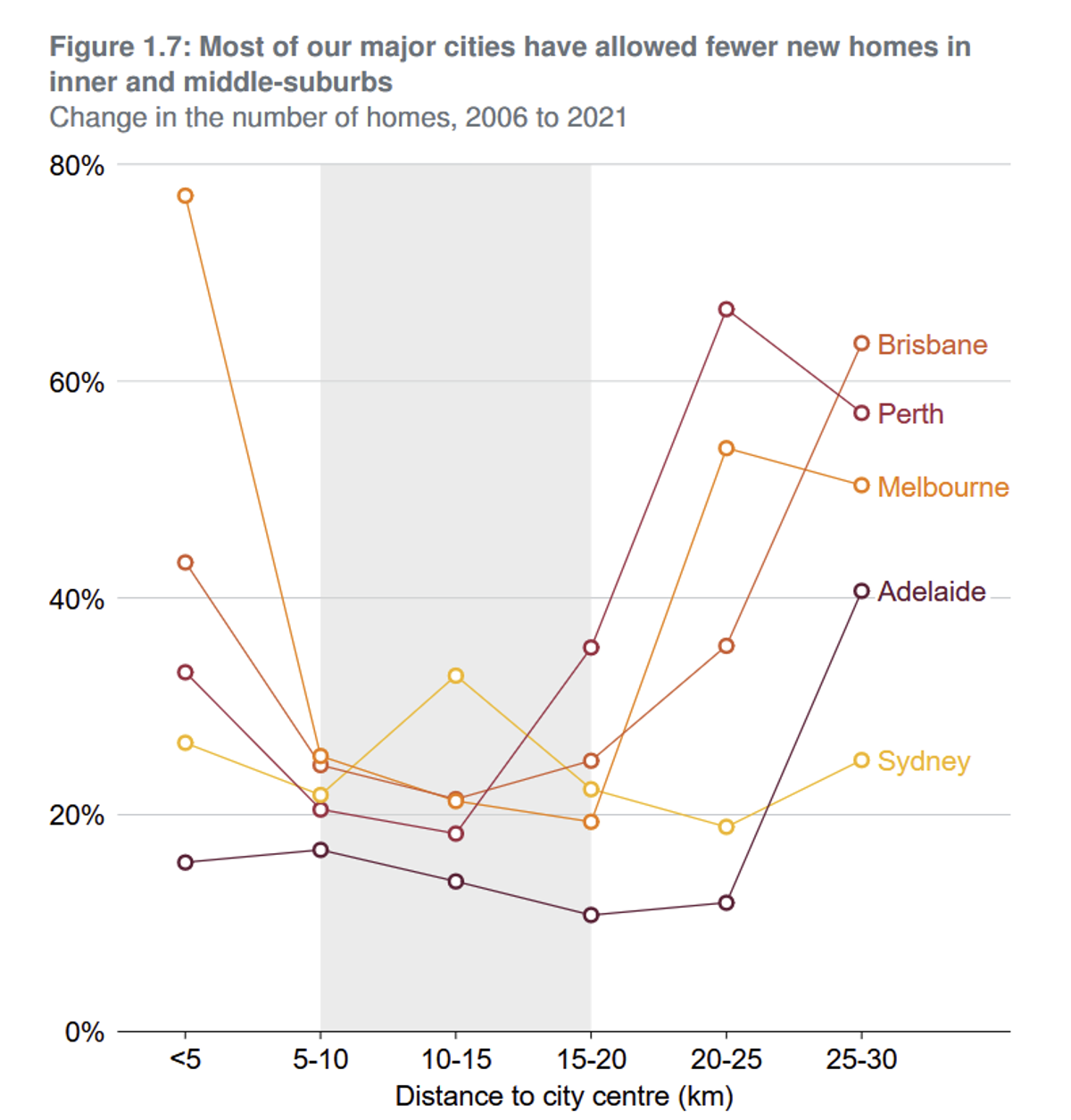
Melbourne has another missing middle: our inner-suburbs. While our outer-suburban growth areas and our CBD have both grown enormously, the middle-ring has not shouldered its share of housing growth. This is because denser, more affordable housing choices have been banned across large swathes of these suburbs, and you cannot build what’s been made illegal in the first place.
What is the difference between social, community, and public housing?
Definitions
+
Community housing: Housing managed and typically owned by not-for-profit organisations.
Public housing: Housing owned and managed by State and Territory Governments.
Social housing: An umbrella term for both community and public housing.
More than 90% of housing in Australia, though, is market housing, provided by private builders and available to buy and sell on the market, or to rent through private landlords.
What is upzoning?
Definitions
+
Upzoning describes changes to planning regulations—whether set at the local or state level—that increase the amount of floorspace it is legal to build on a given piece of land.
This may involve increasing or removing altogether: height limits, minimum lot sizes, setbacks, or any other artificial constraints on building size and layout.
It is worth noting that planning regulations, by definition, can only reduce the total amount of floorspace and housing able to be built on a given piece of land. Upzoning describes any reform that loosens these restrictions, and enables more homes to be built where people want to live.
Auckland provides a classic example of a recent upzoning success. See: Dispelling myths: Reviewing the evidence on zoning reforms in Auckland.
Do you support stronger renter protections?
Housing
+
As a member of the Abundant Housing Network Australia, we at YIMBY Melbourne help draft the following as a part of a submission to the federal rental crisis inquiry:
While we are focused on facilitating greater housing abundance and believe that—in the long term—greater supply will have significant impacts on renters’ bargaining position in housing markets, we acknowledge that supply-side solutions to the rental affordability crisis will take years to have significant downward pressure on prices.
We also recognise that merely improving rental affordability does not address the multitude of other disadvantages while renting.
This is why regulatory changes need to happen to improve the position of renters in the short term and cushion them from retaliatory or knock-on effects that these other much-needed reforms might create.
There will be people—typically on very low incomes—who fall through the cracks. People who are on the social housing waiting list or don’t even try to get on in the first place.
Stronger regulation is both a sword and a shield for these people, whose low market power makes them vulnerable to exploitation but whose economic position means they are unable to access other services.
Many of our members are young renters and many of those have been homeless at some point in their life, so our membership brings broad insights as consumers of rental housing—particularly in the rapidly changing context we face now driven by rapidly growing rents, low vacancy rates and a preponderance of digital intermediaries that sit between renters and their landlord, many of which bring their own hidden fees and extra costs with very little benefit to the renter.
Any reform of renters’ rights—whether these are better lease conditions, price controls, building standards or anything else—should recognise the fundamental power imbalance between a renter and a landlord and improve renters’ bargaining position in the housing market.
Overly bureaucratic systems that expect renters to know and act to enforce their rights fundamentally do not work. This is particularly the case when vacancy rates are so low and landlords have few incentives to keep around “problem” tenants.
National leadership to improve rental regulation is important at this juncture, not least to make renting more easily tractable as people move around our country—but any measures should be assessed for their impact over the short and long term against more than just short-term relief and in particular minimises adversely affect overall housing supply.
By international standards, Australia’s rental regulation overwhelmingly privileges landlords and affords poor protections to renters.
National Cabinet has the opportunity to raise the floor of rental regulation in Australia by setting minimum national standards for renting with a national renters rights accord.
The United States is currently investigating a similar agreement which seeks to set both minimum standards and best practice across access to safe, quality, accessible and affordable housing, clear and fair leases, the education, enforcement, and enhancement of renters rights, renters’ right to organise and on eviction prevention, diversion, and relief.
This, like in Australia, is in the context of rental regulation being seen primarily as within states’ jurisdiction.
In particular, we believe a national renters rights accord should aim to improve renters’ security of tenure, access to information, and lease conditions. It should also aim to reduce the administrative burden borne by renters in enforcing their rights.
Such an accord needs independent oversight and National Cabinet should investigate including a national renters’ voice—whether that is a new agency, a rental commissioner like NSW and Victoria have introduced, or formalising the role of the National Association of Tenants Organisations.
We do not have a strong position on what needs to be in such an accord—but it is important to make sure that any measures introduced are evidence-driven, are best practice, and learn from international experiences.
Likewise we believe it is important that any changes improve renters’ bargaining position in the rental market and have appropriate enforcement mechanisms that do not necessarily rely on the renter initiating a complaints process—whether they rent from a private landlord, a large commercial landlord, a community housing provider or a government agency.
Even regulatory changes will take some time to make major impacts which will come as small comfort for the third of renters at a conservative estimate currently facing rental stress—especially since that rate is likely to grow precipitously for the first time in decades if current trends in advertised rents growth continues much longer.
And like we have stated before, housing affordability must be measured in real and absolute terms, which means prices need to come down or incomes need to go up—and ideally both.
As a short term solution, the Commonwealth should review Commonwealth Rent Assistance payments—and other income support payments like JobSeeker and Youth Allowance— to make sure they are fit for purpose in addressing the cost of living for low income people, and in particular keep up with rental increases. Anglicare has outlined a number of reforms of cut-in rates, rate calculations, documentary evidence and indexation that would improve Commonwealth Rent Assistance.
We do not—in general—support price controls for private rentals except where they create more certainty for renters. In particular, we do not believe blanket “rent caps” and “rent freezes” would improve certainty or affordability and will largely function to encourage retaliation or regulatory avoidance.
However, controls that restrict how often rents can be increased, restrict the reasons for increasing rents, require greater transparency, or constrain rent increases within a lease by requiring fixed amounts or formulae for increases to be included in leases when signed or even advertised would, in our view, help without causing significant negative disruption to the housing market.
To paraphrase ACT Chief Minister Andrew Barr, any price controls should be constructed as flexible safeguards that improve the bargaining position of renters and must be combined with a dramatic increase in both public and private housing supply and robust minimum standards for rental properties and lease conditions.
It is important to remember that there are more costs to renting than just rent prices.
The role rents play in reducing people’s capacity to save money—particularly a home deposit—is well litigated.
Less well-understood are the cost peaks created every time a renter has to move.
These moving costs are a shock, having to pay upfront deposits, bonds, removalists, cleaners and often crossover rent weeks—and increasingly extra fees for applying for rentals, request maintenance or pay rent through “renttech” platforms imposed on renters.
A recent report found that, in NSW at least, the cost of moving house is at minimum $2,000 per person, with the average closer to $3,500 per person.
Renters move far more often than owner-occupiers and in a regulatory context that incentivises high rental turnover and assumes any rental is temporary rather than a long-term home by default, these moving costs are borne by renters over and over again.
In fact, that report found that in the last five years, four in five private renters have moved, one in three have moved multiple times, and one in ten have moved at least once every year—and over a third of those moves are involuntary, a proportion that is likely to grow as rent increases accelerate.
Reforms that aim to improve rental affordability need to also address the causes of involuntary moving—whether that is uncertainty, poor housing conditions or evictions—and also need to smooth out the price peaks associated with moving.
However, as we have repeatedly said, over the long term the only thing that will keep rents down is high rental vacancy rates which we can only achieve through much greater supply of public, community, commons and private housing.
There are already so many apartments. Do we need more?
HousingDefinitionsAbout usMythbusting
+
If you count apartments as a proportion of land use, rather than a proportion of dwellings, it becomes easy to see that we absolutely need more apartments.
One of the counterintuitive things to take into account when measuring a given area's dwelling composition is that a single apartment block, containing (for instance) a total of 50 apartments, can fit on the same amount of land as a single detached home.
This means that if 1 in 50 lots in an area is a medium-density build of 50 apartments, and the other 49 are single detached homes, the area will appear to have more than 50 per cent apartments. Increase this to 2 in 50 lots and two-thirds of the dwellings in an area are apartments.
As you can see in the chart above, just if 50-apartment blocks comprise just 10 per cent of the lots, apartments will comprise 85 per cent of the dwellings.
So while there may be a lot of apartments compared to single detached homes, there are not a lot of apartment buildings.
If you want to learn more about Melbourne's density deficit, we do a full analysis, comparing Melbourne to Paris, in our flagship report, Melbourne's Missing Middle.
What impact do tax concessions have on housing?
Housing
+
The research is clear that tax concessions—such as the Capital Gains Tax discount and Negative Gearing—drive up the demand for housing and that removing them would decrease house prices.
It is estimated that the effect of tax reform would be an approximate 3.3% reduction of existing home prices and 2.9% reduction of new home prices.
YIMBY Melbourne supports these reforms. Even beyond housing, there also is a strong case for winding back these tax concessions on grounds that they perpetuate both wealth and intergenerational inequality.
But these tax concessions are not the primary driver of high housing costs. The primary driver of high housing costs is scarcity.
Zoning restrictions increase home prices far more than 3.3%. The Reserve Bank of Australia found in 2020 that planning restrictions inflated home prices in Melbourne by an average of 20%, and in Sydney by an average of an astronomical 68%. This means that, as Peter Tulip argues, of the $873,000 average 2018 sale price of a new Sydney apartment, $355,000 was attributable to the costs relating to planning restrictions. In Melbourne, planning restrictions added $120,000 to the cost of an apartment in Melbourne.
We support substantial housing tax reform, but we do not pretend it is the be-all end-all of housing policies. Instead, we focus on moves to increase supply—which means unlocking more homes in the places where people most want to live.
What impact does foreign investment have on housing costs?
Housing
+
Foreign ownership is not a major factor in the housing crisis. In fact, it's not a major factor in the housing market at all. At most, 2 per cent of the total housing stock is foreign-owned. Just 0.75 per cent of total sales in 2021 went to foreign buyers.
While it’s intuitive to assume all foreign ownership of housing adds to the total demand of the domestic housing market, there are many situations that it does not. An example of this would be when a parent purchases a home in Australia for their child who is coming here to study. This eliminates the need for the child to rent a separate property when studying.
Additionally, when a property purchased by a non-resident is leased out, this property increases the rental stock the same as if it were purchased and rented out by an Australian resident or citizen. In these examples, you can see that the initial foreign purchase doesn't directly contribute to the increased demand for housing.
Under current policy settings, Australia maintains some of the tightest restrictions on foreign ownership in the world, further constraining their ability to affect our domestic housing market. For example: foreign investors cannot legally buy existing residential properties.
In 2016, a Treasury Working Paper concluded foreign investment only pushed up prices by a small amount—0.5 per cent to 1 per cent of the average increase in Melbourne and Sydney—in the period between 2010 and 2015.
Foreign ownership has only a minor impact on the Australian housing market. Rather than worrying about who owns the homes we have, we should think about how we might go about building more of them.
Why did rents go up during the pandemic?
Housing
+
The pandemic, and the associated shift to work-from-home for many, fundamentally altered the housing needs of many individuals and families.
The RBA highlighted this in a 2023 paper:
During the COVID-19 pandemic, lockdowns and health concerns meant that people desired more space and to live with fewer people. This shift in living preferences contributed to average household size declining to its lowest level in at least a quarter of a century.
The decline in average household size since the start of 2020 – around 1 per cent – is estimated to have contributed to around 120,000 additional households being formed and, as a result, additional demand in the rental market. Average household size has remained low in the face of the recent tightness in the rental market and rising rents. Solid growth in incomes (and, for some, increased working from home [WFH]) has underpinned demand for space.
After the lockdowns ended and interstate and international migration to our cities restarted, the smaller average household size meant there was not enough supply in the market to accommodate the demand, because the same population represented a greater number of households than existed pre-COVID.
The only way to effectively ensure that all the households that formed in the aftermath of COVID can have access to secure housing—is to build enough homes for them to live within.
Is building infrastructure more expensive in established suburbs?
Infrastructure & Transport
+
No, and in fact—the opposite is often true: it’s relatively cheaper to build and maintain infrastructure in existing suburbs. This is because expanding existing capacity is often cheaper than building brand new infrastructure on the city fringe.
Both Infrastructure Victoria and the NSW Productivity Commission found that per-dwelling infrastructure costs are significantly cheaper in established suburbs relative to outer-suburban greenfields. The average per dwelling savings from infill development range from $39,000 to $75,000.
These findings translate internationally. Evidence from New Zealand highlights how higher density housing in the Wellington region lowered the per-dwelling costs of water and road infrastructure. Meanwhile, in Canada, the Metro Vancouver Regional Planning Department found that infrastructure costs are $13,000 per person living in a standalone house but only $2,000 per apartment.
Building more homes in existing areas is not only better for the environment and the housing market, but also for the overall infrastructure costs we face and shoulder as a society.
Aren't new apartments badly built?
Mythbusting
+
Australia’s building and energy efficiency standards have never been higher. While more than 80% of Australian homes have no more than 2 NatHERS stars, all homes constructed under the National Construction Code 2022 are required to be built to at least a 7-star standard. Current building standards represent around a ~73% reduction in energy usage for heating and cooling for new Melbourne homes compared to the average existing dwelling.
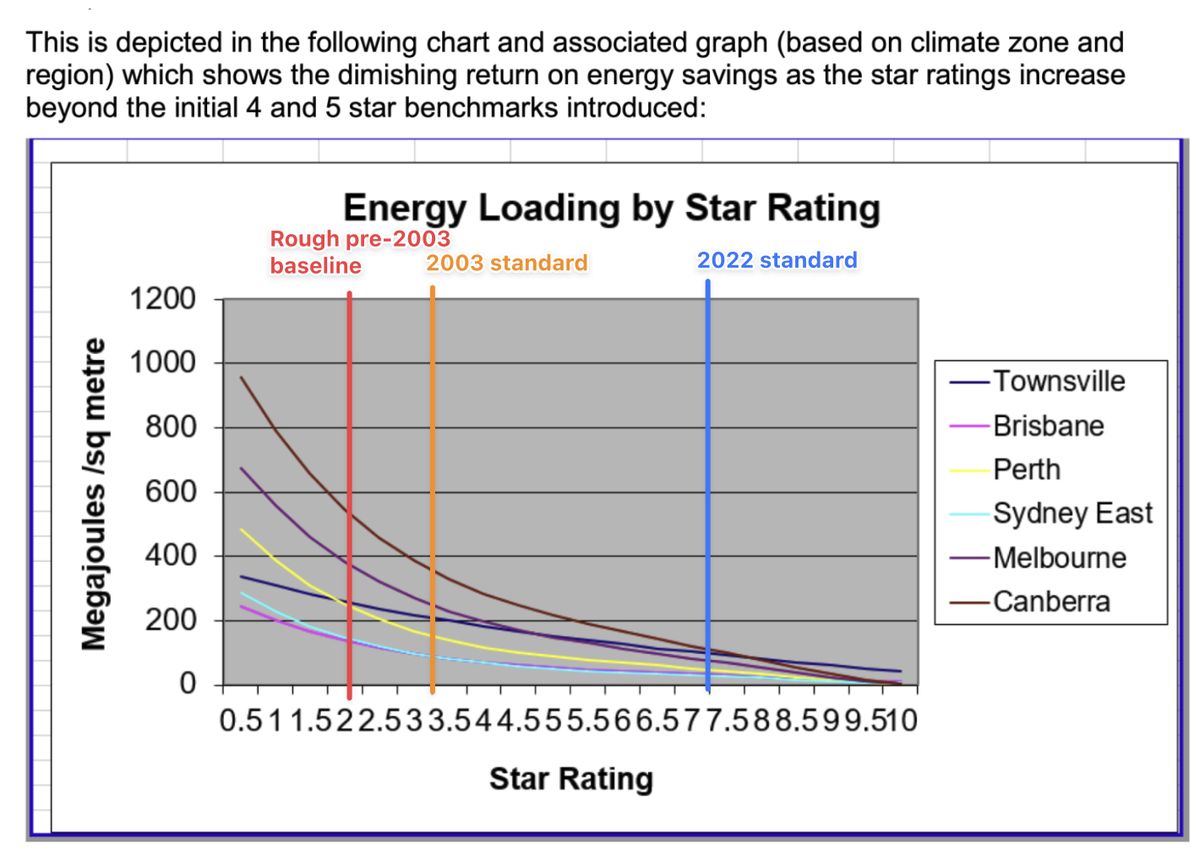
This represents a substantial increase in efficiency in a short period of time. The Australian Housing Conditions Dataset survey showed that homes built over the last four years were more likely to have been rated as being in ‘excellent’ condition than older homes.
There are unquestionably cases of building defects, and we have welcomed work to increase oversight and compensation in these cases. Outside of a small minority of publicised errors, which should not be downplayed, it is worth remembering that new homes are better-built than those constructed in the past.
Aren't there a million vacant homes already?
Mythbusting
+
The ~1 million vacant homes (or 10 per cent of all dwellings) statistic from the 2021 Census is often brought up as evidence of short-term rentals and land banking being primary contributing factors to the housing crisis. However, this misses a lot of context.
Firstly, in every census from 1981 through to 2021, around one in ten dwellings was registered as vacant or empty on census night. The 2021 census confirmed that 9.6 per cent of the dwelling stock was vacant, which was the third-lowest proportion recorded. If vacant homes are a primary cause of the housing crisis, why is the problem only particularly acute now, as opposed to at the time of every other census?
Secondly, it is important to understand why ~10% of dwellings are vacant. Unfortunately, the 2021 Census didn’t include questions about why a given property was vacant, though by using the 2016 Census as a proxy, SGS Economics and Planning highlighted:
It appears that most dwellings that were unoccupied on Census night were unoccupied for a very valid reason. The two largest categories of unoccupied dwelling are Holiday homes or the Residents absent, which accounts for two-thirds of all unoccupied dwellings.
Other reasons why these homes were unoccupied on census night range from being on the market for sale to awaiting demolition. It is key to remember that this is a point-in-time statistic—a snapshot of a single night of the year, and not measuring beyond that.
More in-depth data from the ABS, measuring electricity usage, found that just 1.4 per cent of dwellings across Victoria had no activity over three months. While this data is not perfect either, the longer period does demonstrate very clearly that the proportion of unoccupied homes is far fewer than 10%.
The third thing to understand is where these vacant homes are located. Analysis suggests that the majority of these unoccupied houses are outside of our main cities, with a large number of vacancies attributed to empty holiday homes. The current housing crisis is caused by the lack of supply in key locations, most notably within our cities—not housing stock as a total. Unlocking empty homes in sparsely populated regional areas will not ease this crisis experienced by Melburnians every single day.
Taking this evidence on the whole, it’s unlikely any policy geared toward reducing vacant housing will have a significant alleviating effect on the housing crisis overall. However, there are clear cases such as popular holiday destinations in regional areas where these sorts of policies will greatly assist with housing affordability. We do note, though, that a policy like this needs to be carefully calibrated to not negatively affect accommodation options for people visiting regions that heavily rely on a strong tourism sector.
YIMBY Melbourne welcomes policies aimed at disincentivising the use of homes in supply-scarce areas as short-term rentals (such as Airbnb). However, this should be seen as only a marginal complementary solution to dealing with the housing supply shortage.
Developers only build if they make money, so why would they build anything if prices go down?
Mythbusting
+
It is important to understand that developers care about the margin they can make on the costs of building a home, rather than the sale price.
For example, if a developer can build a home for $500,000 in costs, and sell it for $600,000, they are making a 20% return. But if a developer can build a home for $800,000, and sell it for $900,000, they are making only a 12.5% return.
So long as margins are available at the price people are willing to pay, developers will continue to build. We can see this happening in Melbourne right now, where unit prices have been flat in real terms for half a decade, and yet we have regularly out-built the rest of the nation, even during tough economic times and low prices.
As per UDIA’s State of the Land 2026:
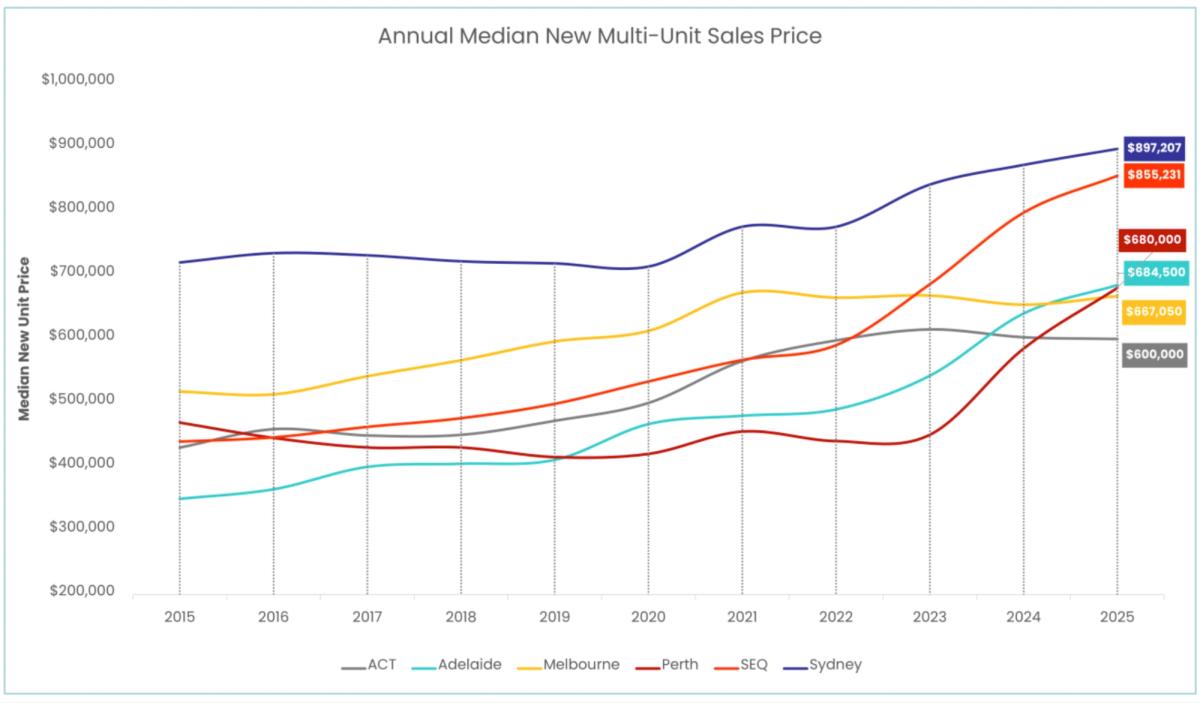
By removing artificial planning restrictions and making land markets more competitive, we can reduce land costs as a portion of new unit development costs. This is what makes planning reform such an important part of housing reform: it’s the main cost lever that governments can influence.
Doesn't new development just push poor people out of the city?
Mythbusting
+
No, and in fact the opposite is generally true: a lack of development pushes poor people out of the city. This is because a lack of new supply drives prices up—whereas an increase in the number of homes drives prices down.
YIMBY Melbourne explored this phenomenon in our research note The Activity Centre Program is redistributive.
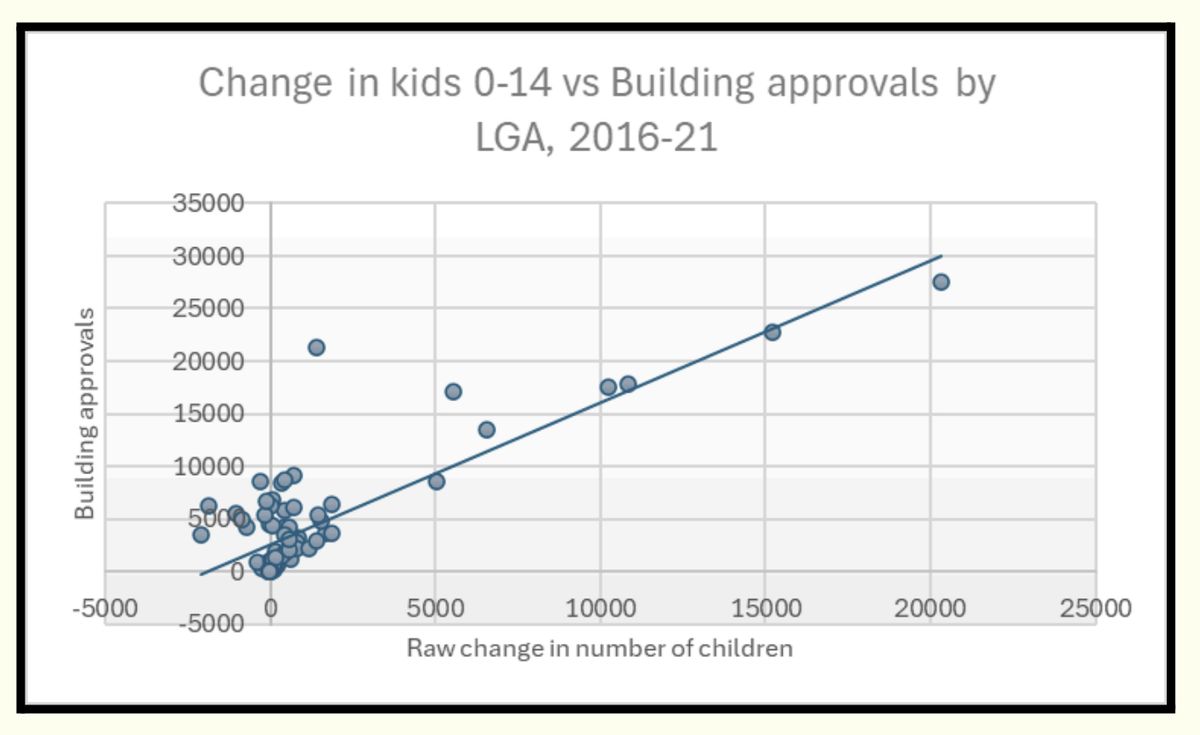
We found that Local Government Areas that approved very little new housing construction saw an associated decline in the population of children. Meanwhile, areas that approved a lot of construction saw a large increase in the number of children.
Restrictions on homebuilding directly result in less supply, which in turn means more competition between homebuyers and renters—leading to higher prices and rents. This is because regulation that bans new housing does not decrease demand for new housing: it just concentrates the demand among a limited supply of existing homes.
In this way, restrictive planning controls push poorer people out of these suburbs all together. Only a stronger provision of housing supply can effectively reduce displacement. Where supply is fixed, housing becomes zero-sum, meaning that one household’s gain is necessarily another household’s loss.
That new supply reduces rents and displacement is substantiated by a large evidence base. For example, a study on the effects of supply increases in San Francisco found that new market-rate construction reduces rents and displacement—a similar study in Sweden found the same.
The only way to stop displacement is to build more homes, so that the residents who might be facing displacement still have somewhere to live.
Don't new housing projects struggle to stack up financially?
Mythbusting
+
It is true that not all projects will be viable at all times. There are always going to be factors beyond our control—be it as simple as interest rates, labour shortages, and supply chain shocks, or as unprecedented as pandemics, global conflicts, and fuel crises.
Only a portion of possible projects will stack up at any given time. The goal of governments should be to enable the maximum number of projects to stack up, even during downturns, which means increasing the number of development options available in a given area.
If we make a basic hypothetical assumption that 1% of possible projects can be built in a given year, the goal should be to increase the total number of possible projects. This is because 1% of 200,000 is larger than 1% of 100,000.
The goal of planning reform is to influence the things that are within our governments’ direct control, so the things that are outside their control have as small an impact as possible during times of weakness, and can bring the maximum benefit during times of growth.
Don't we have enough homes already?
Mythbusting
+
A small portion of dishonest commentators enjoy claiming that Australia has enough homes already, and that we do not need to continue building. This is untrue. While Australia used to grow its housing stock much faster than its adult population, this is no longer the case.
This is not a story about migration, either: the annual growth rate of dwellings has been declining from the 1970s onward.
The shortage is more acute than it appears, because both household sizes and the shape of the economy have changed.
The average household size has dramatically decreased over the past few decades. In the 1980s the average household size was more than 2.8 per home; today the average is closer to 2.5. This means our current population requires almost 1.2 million more homes than if household sizes were still the size they were in the 80s.
The economy has also shifted. There are many extremely affordable homes across regional areas, but they aren’t in the places with access to a diversity of jobs and opportunity. The shortage of homes is most acute in places where people want to live, and where development has been constrained for decades by arbitrary planning controls that drive up housing costs by making it illegal to build denser, more affordable housing in places where people want to live.
Australia needs more homes. Specifically, we need more homes in high-demand, inner-city areas, in line with both changing population demographics and a modern, more services-driven economy.
How do new, expensive developments help poorer renters and homebuyers?
Mythbusting
+
When new market-rate housing is built and occupants move in, they vacate their old homes. In turn, the people moving into those homes vacate their homes, and so on, and so on. This is a vacancy chain in action, where a vacancy at the high-end of the housing market enables people to move into homes that better suit them at a given stage of life.
These moving chains quickly open up new housing for less wealthy households, through a process called ‘filtering’.
In 2021, Evan Mast looked at the individual chains of moves that were caused by new development and found that by the 6th move in the chain, 40% of households are below median income. For a thorough technical overview of moving chains and filtering, you can read this literature overview from economist Michael Wiebe.
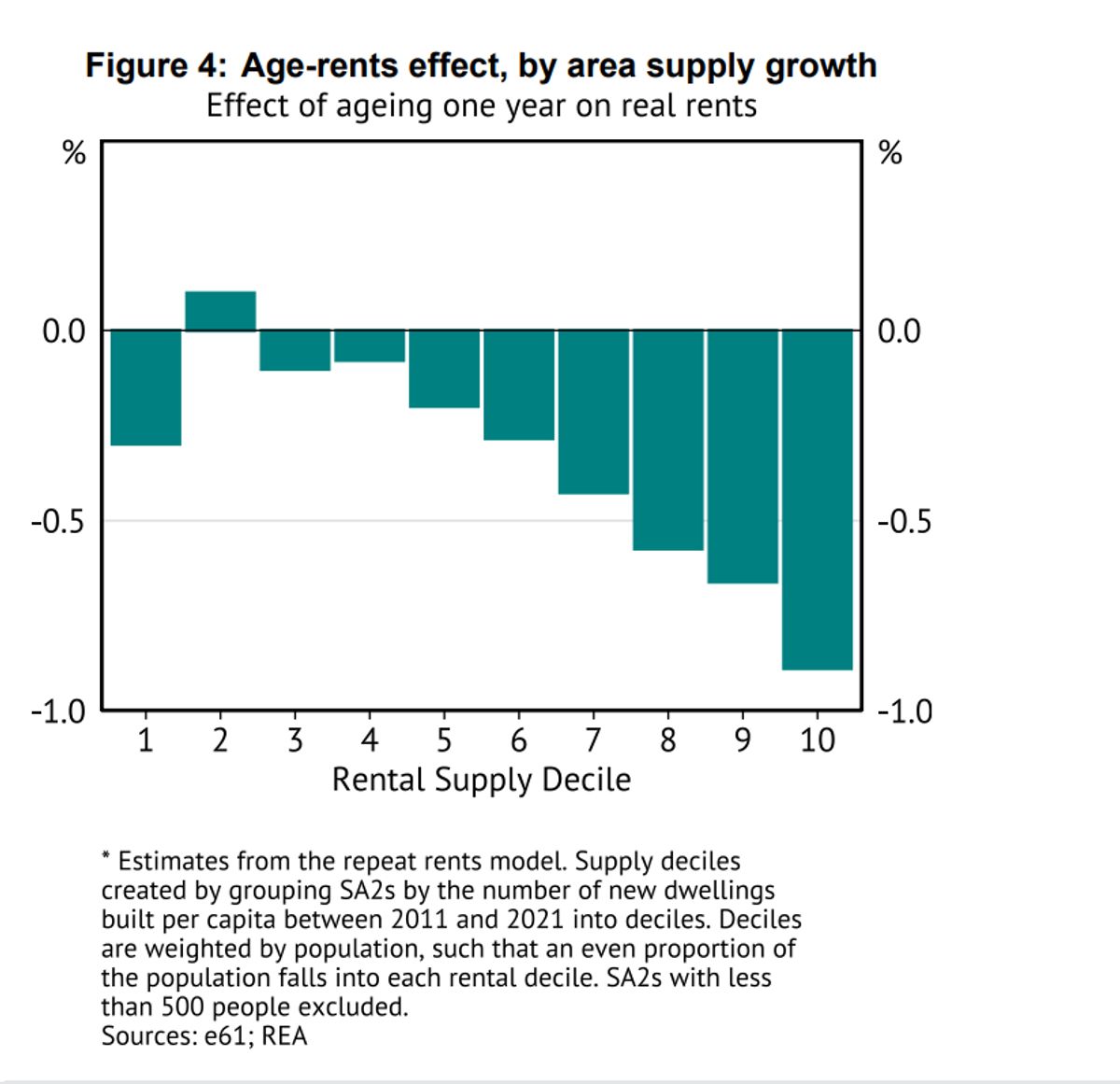
More locally, Australia’s e61 Institute found that on average, a rental property becomes 3.6% cheaper in inflation-adjusted terms as it ages 10 years and that this filtering effect is stronger in areas where more housing is built—with rents decreasing up to 9% for a decade-old home.
The Grattan Institute found that each “1-percentage-point increase in the amount of new housing constructed in a local government area resulted in rents growing 3.7 per cent slower over the decade”.
Moving chains and filtering are sometimes referred to by critics as ‘trickle-down economics’—but this is inaccurate. Trickle-down economics was a very specific set of Reagan-era tax policies. But building homes and cutting taxes are very different things.
More homes enables more people to have more options. It means more bargaining powers for renters, and fewer tradeoffs for buyers. Homes are a consumption good: they enable people to live in a safe, secure dwelling.
More homes in an area enables more people to live there, and to access the amenities, infrastructure, and jobs available. It is an overwhelming good thing to do, and so we should do it.
A simple way to think about increased housing supply is like a game of musical chairs. When there are not enough chairs, the most unlucky players in the game miss out. It’s not really their fault that they miss out: the problem is that there aren’t enough chairs.
But with more chairs, everyone can get a seat. Even if new chairs are fancy—even if they’re thrones, or made of antique oak, or what have you—the existence of these additional chairs enables more people to take a seat. And the goal of progressive, abundant housing policy should be that everyone has a seat.
That is why it’s important that we build more homes where people want to live.
Isn't housing taxed too much, and isn't that a bigger problem than zoning?
Mythbusting
+
The tax treatment of housing is certainly problematic, but it’s worth noting that the most impactful tax on housing is stamp duty—which is paid by the purchaser of the home, rather than the developer.
The Housing Industry Association made the case in 2025 that 32% of a new Melbourne apartment is taxes. It is worth breaking down exactly what this means.
Of the 32% of taxes embedded in apartment prices, they include:
- Income taxes embedded in labour/capital (~14%)
- GST throughout the project (~7.5%)
- Stamp duty (~5%)
- Infrastructure Charges (~4%)
- Other costs of regulatory burden (~1.5%)
Income taxes and GST (~21.5% combined) are paid throughout the entire economy, and should not be considered relevant as a component of housing development costs. The costs of regulatory burden (~1.5%) should be reduced—but they are not high enough to explain the price of housing.
Equally, infrastructure charges (4%) includes core utilities and other components necessary for development to take place in the first place. While YIMBY Melbourne does not assume all infrastructure charges are well-rationalised, this also does not explain high house prices.
One key bad tax here is stamp duty (~5%), which applies to both new and old homes, and which YIMBY Melbourne believes should be abolished and replaced with a broad-based land tax that also applies to the primary place of residence.
Housing is expensive first and foremost not because it is taxed, but because it is scarce. Building more homes where people want to live is the most impactful and effective way to reduce the overall cost of housing.
Isn't planning reform just a handout to big developers?
Mythbusting
+
The biggest developers currently benefit from the scarcity of the restrictive planning status quo, because it enables them to charge a premium, and creates barriers for new entrants. Planning reform is overwhelmingly more beneficial for newer and smaller players than it is for large incumbents.
In a competitive market, developer margins remain thin no matter how many dwellings they're able to build. Research has shown that broad upzoning makes markets more competitive, and enables more small developers to operate viably.
As highlighted in our Missing Middle Housing Targets report, limited zoned capacity creates the potential for land speculation and landbanking. Where there are only a few plots of land where it is possible to build, a small number of speculators can feasibly control and exploit that scarcity to inflate prices. This creates a vicious cycle where the cost of land is driven up, making it harder for developers to build, and for people to buy homes.
Since restrictive zoning significantly increases the costs associated with development, upzoning increases competition while reducing costs to increase supply, bringing about lower prices. For instance, research by Ryan Greenaway-McGrevy on the effects of city-wide upzoning in Auckland, New Zealand suggests that it caused dwelling approvals to surge which has flowed through to increased supply and significantly lower rents in real terms.
The thing that is essential to remember about developers is that they build homes for people to live in: they are an intermediary between fewer and more homes in a given area.
The biggest beneficiaries of development are the people who get to live in those homes. The biggest beneficiaries of planning reform are the people who get to live in homes that were previously illegal to build.
What if I don’t want to live in an apartment?
Mythbusting
+
We believe everybody should have a choice in the type of place that they live, whether that be an apartment, detached home, or townhouse.
As of the 2021 census, 70 percent of dwellings in Australia were detached houses while only 16 per cent were apartments and just 13 per cent were townhouses. Currently, there is a big mismatch between existing housing stock and the housing types that people would prefer for themselves. The Grattan Institute examined this mismatch in their 2011 report, The Housing We’d Choose. For the report, a survey was commissioned asking Melburnians and Sydneysiders about the tradeoffs they would make between location, dwelling size, and dwelling type for their budget. They found that throughout Melbourne, there is not enough semi-detached housing (for example, terraced cottages) and taller (4 or more storeys) apartment buildings, while there were significantly more detached dwellings than people wanted.
Australia already has detached homes in abundance. YIMBYs want to ensure a strong mix of housing types is available to meet the various needs and preferences of all Melbourians, this idea is called 'housing diversity’ and is a key pillar of our ‘Missing Middle’ report. The lack of housing diversity in Melbourne means that our choice of housing type is often dictated to us rather than by us.
Not only is it important to have a wide range of options for prospective buyers and tenants, but increasing density and abundance by delivering the missing middle will have positive flow-on effects for all buyers. This has been demonstrated in Auckland where upzoning efforts supporting housing diversity have led to reduced prices for all housing types, including detached houses.
Why can't the government just build public housing for all?
Mythbusting
+
In 2026, Australia has a total of roughly 11 million dwellings. Acquiring all of these, or building enough new public dwellings, would require trillions in upfront capital plus permanent operating subsidies. Even the most ambitious public housing programs in history haven't aimed at universal provision—they've targeted people in greatest need.
That said, YIMBY Melbourne is a strong advocate for and supporter of an increase in public and community housing, which are experiencing a serious shortage. We also recognise that social housing faces the same planning barriers as private housing, which is why Homes Victoria's Big Housing Build has run into the same neighbourhood opposition faced by private developers.
Public housing specifically faces federal tax barriers to construction, which we have outlined previously in an article for Crikey:
First, state governments, and public housing providers by extension, have to pay GST on the goods and services they consume. Meanwhile, non-profits are exempt from GST, making community housing at least 9% cheaper to build and maintain thanks to federal government taxation settings alone.
The second fiscal imbalance: public housing tenants are not eligible for Commonwealth rental assistance (CRA), while community housing tenants are. This doesn’t usually make a difference to tenant costs, but it does enable community housing providers to charge extra rent to capture a federal subsidy made available to nonprofits — but not to states.
We have advocated for the Commonwealth Government to make these changes, including in our 2025 election policy bible, The Brick Book.
What’s important to remember is that you cannot build housing—public or private—where it is not legal to do so. The first step to building more dense housing is to permit more density. Public housing without zoning reform is fewer public homes in key locations, and a longer waitlist for those who need it.
Why can't we just decentralise or build new cities?
Mythbusting
+
Decentralisation is not an effective solution to the housing crisis. The main appeal of decentralised models is that they effectively maintain the status quo for all current homeowners while putting the full burden of change onto renters and newer Victorians who, under this model, would be forced to relocate to regional centres.
There are many issues with this approach, many of which we outlined in our submission to the Commonwealth Senate’s Inquiry into Productivity in Australia. As per our submission, decentralising Australia’s population would result in:
- Erosion of national productivity: Australia's large cities are the engines of the economy, with 80% of activity occurring on just 0.2% of land. Diverting workers to regional areas through urban containment would create a "productivity ceiling" and deprive workers of the higher wages and more productive work found in dense, high-matching labor markets.
- High-cost fiscal inefficiency: Implementing a National Settlement Strategy would require massive public subsidies to incentivise businesses and residents to move to places they would not otherwise choose.
- Economic welfare loss: The social and economic harm of decentralisation go well beyond costs to the state. A National Settlement Strategy would require micromanagement of land and development by a central authority, and would result in enormous inefficiencies as the government works against—rather than with—the will of its constituents.
- Long-run policy misdirection: Spatial policies reliant on inaccurate long-term projections create destructive feedback loops frequently used to justify further more expensive, unproductive policy interventions.
- Environmental damage: Any attempts to decentralise our population will definitionally require more inefficient land use. Dense, thriving cities reduce transport emissions and forego the need to clear huge amounts of land to accommodate sprawl in the regions.
The high costs of regional infrastructure mean that decentralisation will also likely be very expensive, and in many cases incredibly difficult to achieve at all. This bears out in the analysis: a 2023 Infrastructure Victoria report highlighted that Victoria will be 31 billion dollars worse off in terms of infrastructure spending by 2056 if we pursue a decentralised ‘network of cities’ model over a more compact city.
True productivity will come not from more intervention in Australian land use, but less. By removing the "productivity ceiling" imposed by urban containment, we can enable our major cities to grow and mature by allowing an increase in both dense housing supply and commercial floorspace. This, in turn, will enable more Australians to access the high-wage, high-productivity opportunities that only large, dense urban cities can provide.
It is also worth noting that existing Australian cities and towns are around about the size you’d expect:
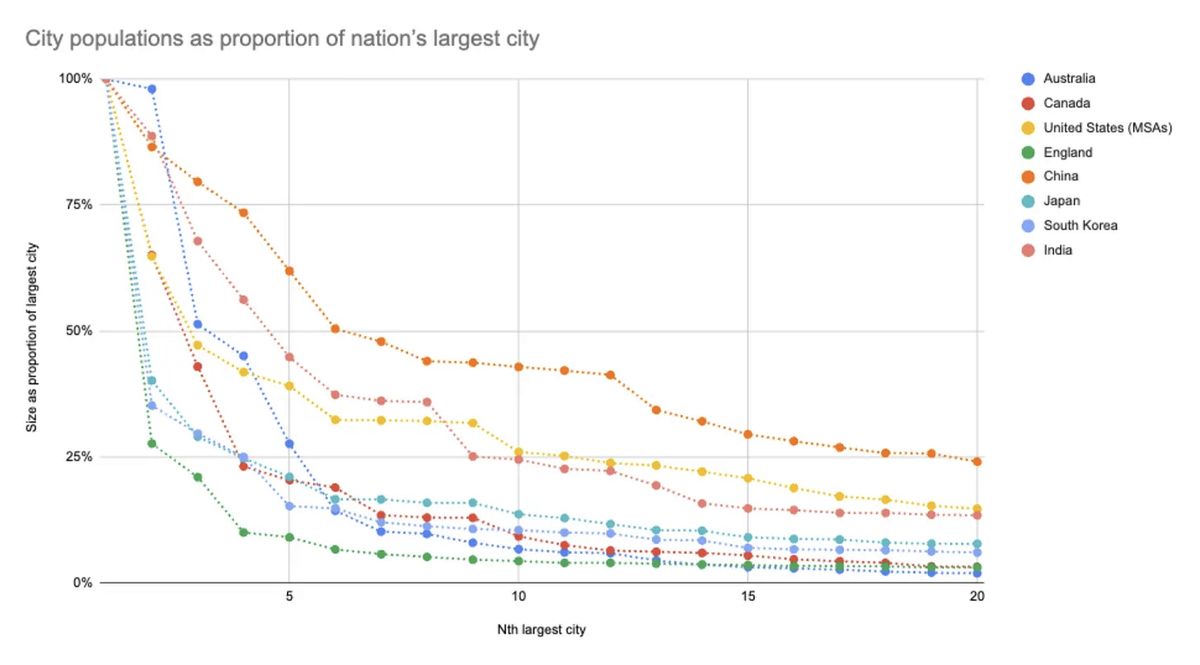
Australia’s history is filled with examples of failed attempts at decentralisation—we ought not to repeat the same mistakes.
Forced decentralisation when broken down to its core is a subsidy program for status quo homeowners at the expense of marginalised and future Melbourians. YIMBY Melbourne simply believes we should build more homes where people want to live, rather than forcing people to live somewhere else at great public and private cost.
Will more homes in established suburbs overload existing infrastructure?
Mythbusting
+
While more people absolutely bring with them a higher demand for infrastructure, that is a far cry from that infrastructure being overloaded. Development occurs over multiple years, giving local councils and other authorities ample time to respond to increases in density and residents.
The good news is that because a large proportion of infrastructure costs are fixed, they do not meaningfully increase with population. For example, the number of footpaths you need does not increase as more people join your neighbourhood. In fact, a greater number of residents will often make maintenance and upgrades cheaper on a per-person basis.
Right now, many of our established neighbourhoods are in decline, and seeing demand for services such as school enrollments collapse, for example. This is a part of the “tombstone suburb” phenomenon, where restrictive planning controls are creating suburbs of demographic and population decline. At the extreme end of the scale, this has resulted in successive governments spending billions upon billions of public money to build new transport infrastructure, only for it to be surrounded exclusively by a few detached houses.
New housing projects pay significant infrastructure levies. For example, in the areas upzoned by the Victorian Government’s Activity Centre Program, all new homes will pay more than $10,000 in contributions toward local infrastructure. The ‘growth pays for growth’ model has long been a cornerstone of Australia’s housing systems, and it continues to underpin the reforms currently being undertaken across Melbourne.
Won't stopping migration solve the housing crisis?
Mythbusting
+
No. And it is important to note that using immigration statistics as a rebuttal to YIMBY positions is a fundamental misdirect. YIMBY Melbourne, and YIMBY groups across Australia and the world, want to see legislative and planning reform to enable more homes to be built where people want to live.
Even if we halted immigration tomorrow, there would still be a systemic shortage of homes in the key areas of our cities where land prices are high and density is restricted.
The zoning and planning reforms required to create bigger, better cities cannot be substituted by a reduction in migration. The positive economies of scale associated with allowing our cities to densify around infrastructure and employment are beneficial regardless of migration rates, and these planning reforms should be enacted regardless of immigration policy settings.
The benefits of broad upzoning and other reforms go well beyond affordability arguments, and have positive impacts on the environment, liveability, and economy of a given place. These positive impacts of densification are laid out thoroughly in our flagship report, Melbourne's Missing Middle.
Insofar as immigration affects house prices, the overall effect is by no means the most significant factor. While it is true that immigration increases demand, and therefore puts upward pressure on prices, 2019 research from Moallemi and Melser finds that between 2006 and 2016 "Australian housing prices would have been around 1.1% lower per annum had there been no immigration”. This is not insignificant, of course, but cannot be treated as the defining cause of housing unaffordability, when prices over that same period increased by 5.95% per annum.
At least 80% of house price growth is unrelated to immigration. We should work to address this significantly larger set of house price growth drivers, rather than focusing unnecessarily on the 20% associated with immigration, especially given the externalities of a more restrictive immigration policy.
It would be a grave mistake to address an economically destructive, reactionary housing policy with an economically destructive, reactionary immigration policy. Instead, we should focus our energy on reforming the byzantine restrictions that stop homes being built where people want to live.
How do planning restrictions impact public and social housing development?
Planning & Heritage
+
The same zoning rules and approval processes that constrain private development also constrain public and community housing, particularly in well-located areas with good transport and amenity.
And social housing development typically faces more neighbourhood opposition than private development equivalents.
This is why in the wake of the Global Financial Crisis, the Victorian Government amended the planning scheme so that its social housing agency had complete control over permitting. First, they removed planning approval responsibilities for stimulus-funded projects from local planning departments. Then, they exempted all social housing from objections and third-party appeals to ensure it was built quickly and protected from lengthy VCAT battles.
The Victorian Government even went as far as delegating planning permitting to Community Housing Providers and State Housing Agencies, allowing them to engage with planning consultants to “pre-approve” their own planning permits.
The result was the approval timeline collapsing to just four weeks from start to finish (the average approval timeline from 2015 to 2020 was around 17 weeks).
The history of the planning system is countless cases like the above: when we are in desperate need of something, we fast-track it, skipping over as much of the system as possible in order to achieve the outcomes that we want.
We cannot have a mass social housing build without meaningful planning reform. We should do both.
Should the local community get the final say on what developments happen near them?
Planning & Heritage
+
Considering the preferences of the local community is important—but it cannot be the only voice our planning system hears.
As outlined in our research note, Community consultation is unrepresentative and biased, community consultation is unrepresentative and biased. Current legacy planning processes advantage the voices of incumbent landowners, while ignoring the most important voices: those of people who want to live somewhere but can't. These are the voices that the YIMBY movement represents.
Over the past six decades, a deep status-quo bias has been embedded within our planning system, which has consistently failed to engage with the needs and preferences of potential future residents.
This bias is most deeply felt during hyper-local, development-by-development consultation, which generates a large number of problems, including:
- A high level of planning process burden, requiring planners to go to great lengths to defend fully compliant development applications to councillors and a small minority of the community whose favourite hobby is objecting to new housing.
- An increased degree of uncertainty and costs for developers, as even a fully compliant development can be knocked back for arbitrary reasons.
- An unreasonable amount of power being given to vibes-based decision-making of elected non-professionals, subject to political pressures that do not align with the system’s objective of delivering homes.
- A reduction in the delivery of social housing, which typically faces greater community pushback than equivalent market-rate development.
Resident input, therefore, should be undertaken earlier in the piece, and with clear parameters, such as ambitious, binding housing targets that ensure saying no to more homes is not a viable option for local governments and their consultation outcomes.
To combat the housing crisis, homes must be delivered across all of Melbourne's Local Government Areas. This means that incumbent residents cannot have the final say: we have to prioritise the broader benefits that accrue to society and future residents, rather than kowtowing to the parochial complaints of incumbent landowners.
What impact do heritage restrictions have on housing?
Planning & Heritage
+
Heritage restrictions apply to a large portion of land within inner-middle Melbourne, and make development very difficult—often precluding it entirely. Heritage controls increase build costs and reduce yield, and often impose requirements that make development unviable.
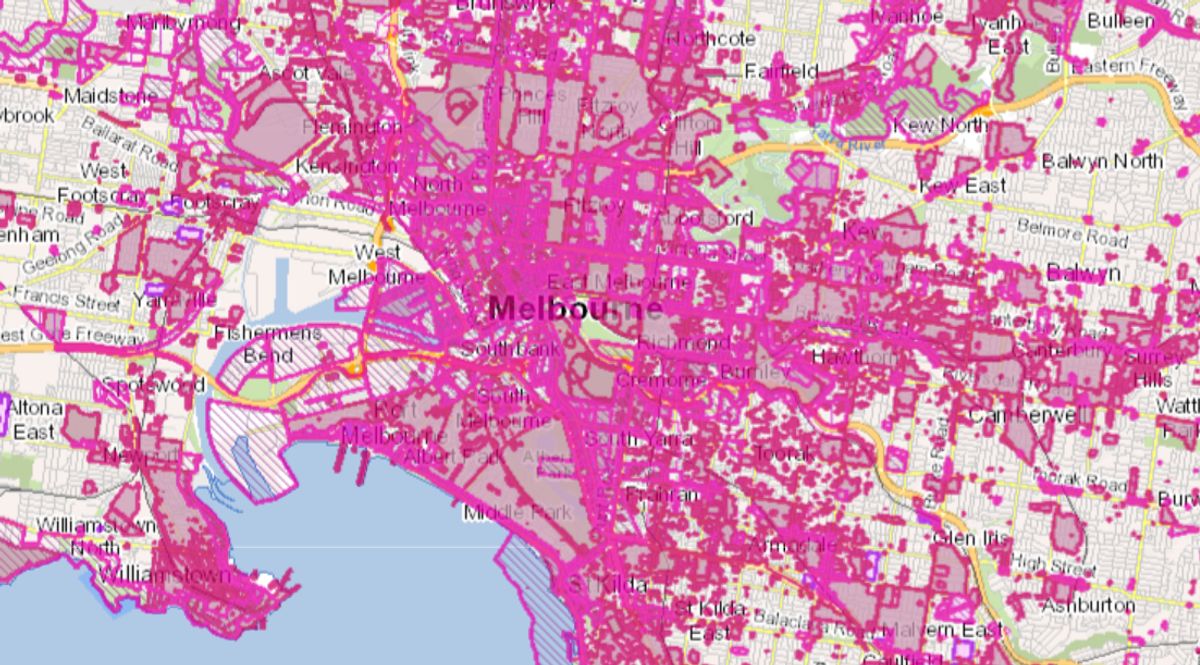
The map above demonstrates the proliferation of heritage overlays across Melbourne. By virtue of the inner-city being built out first, these controls predominantly cover the inner-city suburbs with the best access to public transport, jobs, and other high-quality amenities.
The consequence of trying to keep so many of our most desirable areas locked in amber means that we have limited our ability to build homes where people want to live. Heritage controls prioritise the city of the past over and above the city of the future.
While there are clear examples of buildings and areas that we should protect, it cannot be that it applies to all the structures and land currently subject to heritage overlays. This is particularly true given that we increasingly see heritage overlays being weaponised in order to block housing, with bad-faith actors reshaping heritage overlays into a tool explicitly used to lock new residents out of amenity-rich areas.
There are also many very silly examples of heritage. From brutalist multi-level carparks in Carlton, to dozens of disused substations across Melbourne, to derelict factories—all of these are examples of buildings preserved via heritage overlays. In 2023, a redevelopment around a substation was approved, but with a large reduction in the number of apartments delivered. Recent examples of unremarkable heritage controls have highlighted that the army of heritage consultants are beginning to consider classifying anything built pre-1970s as worthy of heritage listing.
A serious reckoning with heritage controls is required. YIMBY Melbourne looks forward to releasing in-depth research on this later in 2026.